- StatusСтатус
- Visual conceptВизуальный концепт
- PlatformПлатформа
- Ocean-going tankerМорской танкер
- Wind layerВетровой слой
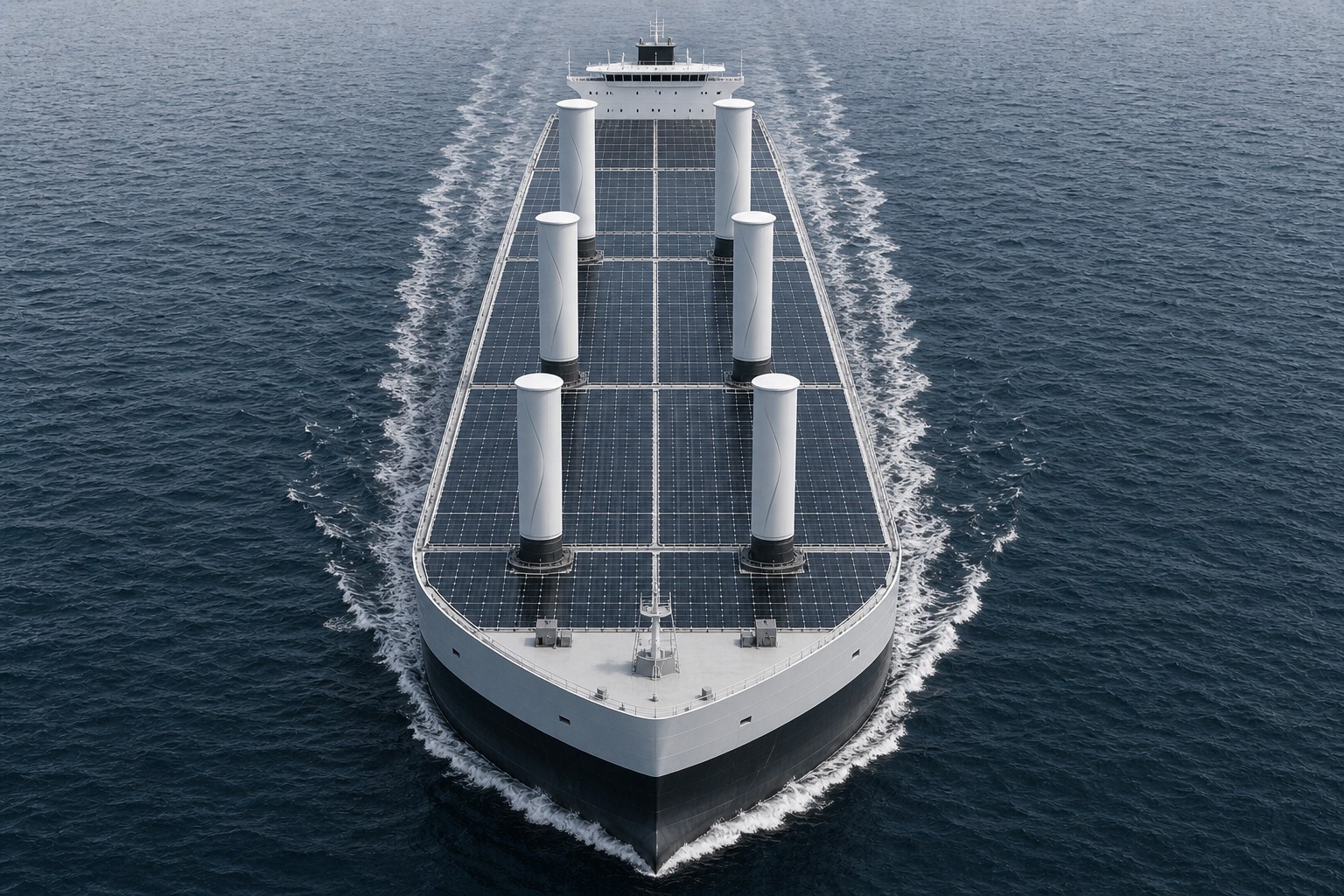
- Six rotor sailsШесть роторных парусов
- Solar layerСолнечный слой
- Deck-integrated PVИнтегрированные фотоэлектрические панели
- ControlУправление
- Adaptive energy managerАдаптивный энергоменеджер
01 / The proposition
Efficiency is an orchestration problem
The image is not a finished vessel specification. It is an architectural proposition: instead of treating every efficiency technology as a separate accessory, the tanker combines wind, sun, route data and onboard demand into one controllable energy system.
A tanker is an especially interesting platform for this exercise. Its long passages create time for cumulative savings, while its broad upper surface offers an unusually large collection area. Those advantages come with real constraints: cargo access, hazardous-area rules, maintenance paths, structural loads and the need to keep every system serviceable in salt water.
The central idea is not to replace the engine with one alternative source. It is to make the engine do less work whenever the environment can safely contribute.
02 / Energy layers
One vessel, three coordinated layers
Wind assistance
Six vertical rotor sails create aerodynamic thrust when wind direction, vessel speed and route geometry are favourable. They supplement propulsion rather than dictate it.
Solar surface
The photovoltaic deck supports hotel loads, pumps, sensors and storage. Its value lies in reducing auxiliary generation across long operating hours.
Adaptive control
A supervisory layer compares weather, route, shaft load, battery state and operational priorities before deciding which source should contribute.
Operational design
Maintenance access, shadows, salt contamination, cargo operations and emergency procedures are treated as design inputs, not late exceptions.
Wind is useful only when the system knows how to use it
Rotor sails exploit the aerodynamic force generated by a spinning cylinder in moving air. On the right heading they can provide forward thrust and lower the propulsion demand. On an unfavourable leg they may offer little benefit, consume power or create handling constraints. The practical system therefore needs route-aware control rather than a simple on/off command.
The control layer can evaluate forecast wind, waves, arrival time, engine efficiency and the energy required to spin each rotor. It can then choose between maximum assistance, minimum fuel consumption, schedule protection or safe stowage of the wind system.
The deck becomes an energy surface
In the concept, the upper deck is visually read as one continuous photovoltaic field. A buildable version would be more fragmented. Walkways, inspection points, pipework, ventilation, fire zones and cargo equipment must remain accessible. Panels also need a strategy for salt, spray, heat, vibration and partial shading from the rotors.
Solar power would not be expected to propel a tanker by itself. Its role is quieter but still useful: feeding onboard electrical demand, charging a buffer battery and reducing generator runtime when conditions permit.
03 / What must be proven
From image to engineering programme
The concept becomes credible only after route-specific simulation. The next stage would model wind statistics, sun exposure, hull resistance, rotor power draw, usable deck area, additional mass and the effect of every installation on cargo operations. Savings should be reported as ranges for defined routes and speeds, not as a universal percentage.
A technical programme would also test structural foundations, fatigue, electromagnetic compatibility, firefighting access, hazardous-area compliance and failure modes. The best result may not use six rotors or cover the entire deck. The purpose of the blueprint is to expose the system question clearly enough for those trade-offs to begin.
← BACK TO BLUEPRINTS01 / 0301 / Предложение
Эффективность — задача оркестрации
На изображении не готовая спецификация судна, а архитектурное предложение. Вместо набора независимых устройств танкер объединяет ветер, солнце, данные о маршруте и бортовое потребление в одну управляемую энергетическую систему.
Танкер особенно интересен для такого эксперимента. Длительные переходы позволяют накапливать эффект от небольших улучшений, а широкая верхняя поверхность даёт большую площадь для сбора энергии. Но у этих преимуществ есть ограничения: доступ к грузовым системам, требования опасных зон, маршруты обслуживания, конструкционные нагрузки и работа оборудования в солёной воде.
Главная идея не в том, чтобы заменить двигатель одним альтернативным источником. Задача — уменьшать его работу всякий раз, когда окружающая среда может безопасно помочь.
02 / Энергетические слои
Одно судно, три согласованных слоя
Помощь ветра
Шесть вертикальных роторных парусов создают аэродинамическую тягу, когда направление ветра, скорость судна и геометрия маршрута этому благоприятствуют.
Солнечная поверхность
Фотоэлектрическая палуба питает общесудовые нагрузки, насосы, датчики и накопитель, сокращая время работы вспомогательной генерации.
Адаптивное управление
Надсистемный контроллер сопоставляет погоду, маршрут, нагрузку на вал, заряд батареи и эксплуатационные приоритеты.
Эксплуатационный дизайн
Доступ для обслуживания, затенение, солевые загрязнения, грузовые операции и аварийные процедуры становятся исходными условиями проекта.
Ветер полезен, только если система умеет им управлять
Роторные паруса используют аэродинамическую силу, возникающую у вращающегося цилиндра в потоке воздуха. На подходящем курсе они создают дополнительную тягу и снижают потребность в мощности главной установки. На невыгодном участке эффект может быть мал, а сами роторы будут потреблять энергию или усложнять управление. Поэтому практической системе нужен маршрутно-зависимый режим, а не простая кнопка включения.
Контур управления может учитывать прогноз ветра, волнение, расчётное время прибытия, эффективность двигателя и энергию на вращение каждого ротора. На этой основе выбирается режим: максимальная помощь, минимальный расход топлива, сохранение графика или безопасное отключение ветровой подсистемы.
Палуба становится энергетической поверхностью
В концепте верхняя палуба читается как сплошное фотоэлектрическое поле. Реализуемая версия будет более фрагментированной: проходы, точки осмотра, трубопроводы, вентиляция, пожарные зоны и грузовое оборудование должны оставаться доступными. Для панелей также потребуется стратегия защиты от соли, брызг, нагрева, вибраций и частичного затенения роторами.
Солнечная генерация не должна самостоятельно двигать танкер. Её роль скромнее, но практически значима: питание бортовой электрики, заряд буферного накопителя и сокращение времени работы генераторов при подходящих условиях.
03 / Что необходимо доказать
От изображения к инженерной программе
Концепт становится убедительным только после моделирования конкретных маршрутов. Следующий этап должен учитывать статистику ветра, инсоляцию, сопротивление корпуса, потребление роторов, полезную площадь палубы, дополнительную массу и влияние каждой установки на грузовые операции. Экономию корректно показывать диапазоном для заданного маршрута и скорости, а не одной универсальной цифрой.
Инженерная программа также должна проверить фундаменты, усталостные нагрузки, электромагнитную совместимость, доступ пожарных систем, требования опасных зон и сценарии отказа. В оптимальной конфигурации может оказаться не шесть роторов и не сплошная солнечная палуба. Задача этого blueprint — сформулировать системный вопрос достаточно ясно, чтобы началась работа с реальными компромиссами.
← НАЗАД К КОНЦЕПТАМ01 / 03