- StatusСтатус
- Visual conceptВизуальный концепт
- CollectorГенератор
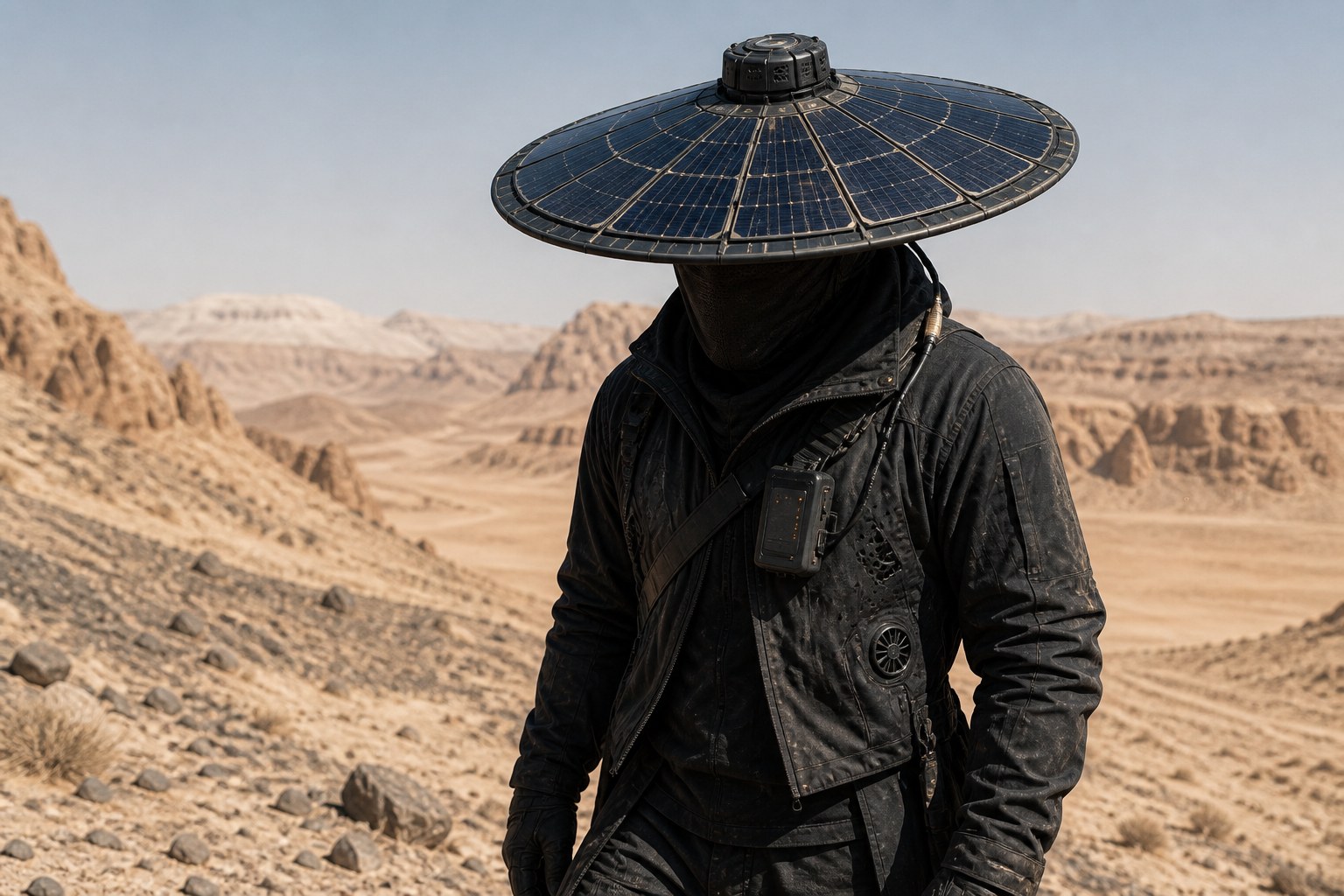
- Photovoltaic hat brimФотоэлектрические поля шляпы
- StorageНакопитель
- Removable battery packСъёмный аккумулятор
- CoolingОхлаждение
- Head and torso airflowОбдув головы и корпуса
- PriorityПриоритет
- Shade before refrigerationТень прежде охлаждения
01 / The proposition
Wear the collector where sunlight is strongest.
The wide brim is both a passive heat-control surface and the largest practical photovoltaic area on the body. Its segmented cells shade the head, face and shoulders while feeding a regulated low-voltage bus. Black outer fabric is selected for durability and light management, but it is kept away from the skin by ventilated spacer layers.
The system does not try to air-condition a person. It spends a small solar budget exactly where evaporation and airflow matter most.
02 / Energy and cooling loop
Photovoltaic brim
Radial cell segments tolerate curvature and partial shade. Maximum-power-point control stabilizes their variable output while the wearer moves.
Buffer and distribution
A removable battery stores surplus energy. A protected low-voltage bus prioritizes cooling, then sensors, communications or charging.
Head cooling
Micro-blowers in the crown move air across a spacer liner and exhaust warm, humid air around the brim without sealing the head.
Garment airflow
Low-profile fans pulse air through collar and torso channels; moisture-wicking inner layers spread evaporation across a larger surface.
03 / Limits
Solar area is useful, not limitless.
Available power falls with shade, dust, panel angle and cell temperature. A wearable collector can realistically support efficient fans and electronics, but sustained thermoelectric or compressor cooling would demand more area and battery mass. The broad brim adds wind load; wiring must survive flexing and sweat; batteries need impact, water and thermal protection. Black fabric also raises absorbed heat unless reflective coatings, air gaps and continuous ventilation offset it. The concept therefore remains an aid to shade, hydration and work-rest discipline—not a substitute for them.
← BACK TO BLUEPRINTS03 / 0301 / Предложение
Разместить генератор там, где солнце сильнее всего.
Широкие поля одновременно создают пассивную тепловую защиту и дают максимально практичную площадь фотоэлементов на теле. Сегментированные ячейки затеняют голову, лицо и плечи, питая стабилизированную низковольтную шину. Чёрная внешняя ткань выбрана за прочность и контроль света, но отделена от кожи вентилируемыми объёмными слоями.
Система не пытается кондиционировать человека целиком. Она расходует небольшой солнечный бюджет там, где испарение и поток воздуха дают наибольший эффект.
02 / Контур энергии и охлаждения
Фотоэлектрические поля
Радиальные сегменты переносят кривизну и частичное затенение. MPPT-контроллер стабилизирует меняющуюся при движении мощность.
Буфер и распределение
Съёмный аккумулятор сохраняет избыток энергии. Защищённая низковольтная шина сначала питает охлаждение, затем датчики, связь или зарядку.
Охлаждение головы
Микровентиляторы в тулье проводят воздух через объёмную подкладку и выводят нагретый влажный воздух по краю полей.
Обдув одежды
Низкопрофильные вентиляторы импульсно подают воздух в каналы воротника и корпуса, а влагоотводящий слой распределяет испарение.
03 / Ограничения
Площадь солнечного коллектора полезна, но ограничена.
Доступная мощность падает в тени, из-за пыли, угла к солнцу и нагрева ячеек. Носимый генератор способен питать эффективные вентиляторы и электронику, но длительное термоэлектрическое или компрессорное охлаждение потребует большей площади и тяжёлой батареи. Широкие поля создают ветровую нагрузку; проводка должна выдерживать изгибы и пот; аккумулятору нужны защита от ударов, воды и перегрева. Чёрная ткань сама поглощает тепло, если это не компенсируют отражающие покрытия, воздушные зазоры и постоянная вентиляция. Поэтому концепт дополняет тень, воду и режим труда и отдыха, но не заменяет их.
← НАЗАД К КОНЦЕПТАМ03 / 03